
Chess sondes aid storms research
On the River Chess we run four sondes as part of the ChessWatch collaboration with QMUL and the Smarter Water Catchment monitoring programme.
Sondes are continuous water quality monitoring equipment, recording multiple parameters including dissolved oxygen, temperature, pH, conductivity, turbidity and ammonium at 15 minute intervals. The four sondes have been in place since 2019 providing a rich longterm dataset that can be used to interrogate water quality changes over long timescales as well as identify pollution events at short timescales.
Maintaining the sonde network is a collaborative job: CCSP and QMUL staff calibrate the sondes each month, citizen scientists clean the sondes in between visits, and another citizen scientist, Hefin, uploads the data to a public water quality dashboard.
The sonde data is open and accessible to view here – ChessWatch water quality data
If you have any questions about the sondes, or would be interested in using this data for research please contact chalkstreams@chilterns.org.uk
Example - Storm Austen (23rd October) and Storm Boelo (24-25th October)
One of the many ways that the sonde data can be used is for event detection, to investigate changes in water quality. This can be used to show pollution events including the impact of sewage or runoff. Recently we used it to look at the effects of the first two storms of the season.
Loudwater Sonde
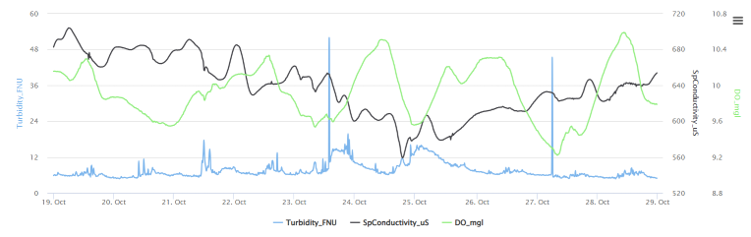
In the graph below you can see evident spikes in Turbidity during Storm Austen and Storm Boelo associated with runoff causing sediment erosion. The effect of runoff causing increased turbidity is often more severe at the start of the season as dry dusty soil is more vulnerable to erosion. This spike in turbidity corresponds with a drop in Dissolved Oxygen and Conductivity, showing the dilution effect from rainwater entering the system.
Elms Lake sonde
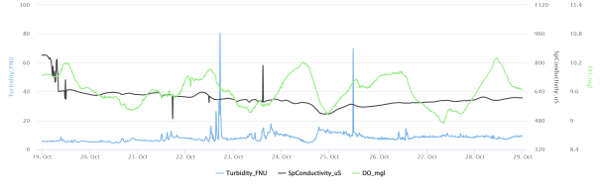
This site sees an even more severe spike in Turbidity during the storm events on 23rd and 25th October – peaking up to ~80 FNU compared to the Loudwater peak of ~50 FNU. This is followed by a drop in Dissolved Oxygen and Conductivity.
To find out more about the effects of storms and other ‘hot moments’ of river pollution then book on to our upcoming citizen science evening to hear from the SmartWater team. Mike Bowes from CEH will be showcasing research on first flush storm events detected with sondes, and Megan Gawith and Hannah Perriton from the EA will be presenting their work on stakeholder mapping of pollution hot moments and hot spots.