

Fighting back against Floating Pennywort
The River Misbourne, is a Chalk Stream in the Chilterns National Landscape with a known issue of an invasive non-native water loving plant called Floating Pennywort (Hydrocotyle ranunculoides).
It has round leaves, with a frilly edge, and a notch where the leaf stalk joins the leaf, and long trailing stems. It grows very quickly (up to 20cm a day) and can form dense mats that block sunlight, reduce oxygen and outcompete native plants. Even a small fragment can also grow into new plants, making it difficult to control. Originally from Central & South America, it was introduced into the UK in ornamental ponds and quickly escaped.
Management can include regular monitoring, careful physical removal, safe disposal, good biosecurity (from any person, animal, or appliance coming into direct contact with the water) and, where appropriate, with professional herbicide treatment. Using several methods together gives the best chance of controlling the plant and preventing it from spreading.
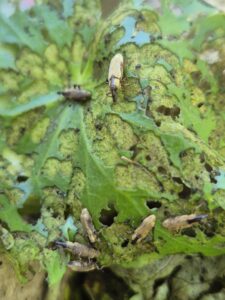 The Chilterns Chalk Streams Project, through Mending the Misbourne, is working with CABI to identify release sites for the Pennywort Weevil (Listronotus elongatus) a small, rice-sized insect from South America, where it naturally feeds on floating pennywort and is helping to control the plant in the Misbourne. This small weevil is specially adapted to feed on floating pennywort. Its long snout/nose and strong mouthparts help it feed on the plant, while females lay their eggs inside the plant’s leaf stalks. The larvae then tunnel through the stalks and underwater stems, damaging the plant from the inside. Different stages of the weevil’s lifecycle therefore attack different parts of the pennywort.
The weevil has been carefully tested by CABI to make sure it is highly specific to floating pennywort and does not harm important native plants. The work involves having a special license and has long term monitoring to assess its success in lasting management, by naturally weakening pennywort and reducing its survival.
By focusing control efforts on the chalk-stream headwaters, like the Misbourne, we can help prevent floating pennywort spreading through the River Colne Catchment and protect the special freshwater habitats of the Chilterns National Landscape for the future. The selected sites on the Misborune for Weevil release, have been funded by Affinity Water. Please remember if you are near or entering a river to Check, Clean, Dry and if you spot an Invasive Non Native Plant, you can record a sighting on INNS Maper with a photo and location.