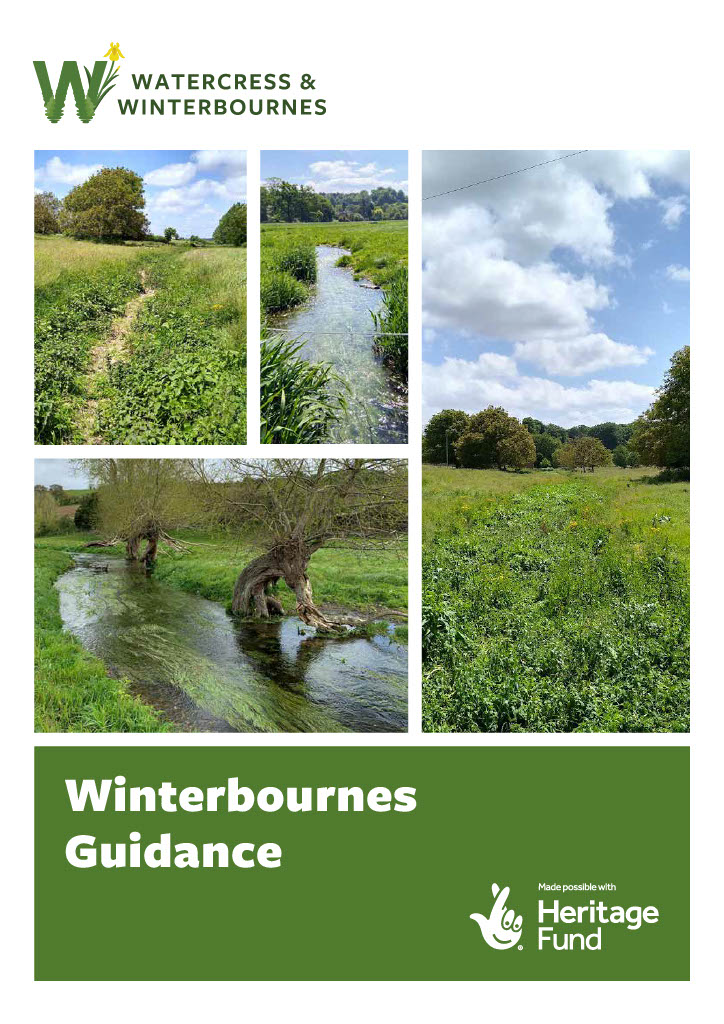

Winterbourne Management Guidance
We are delighted to have supported in the creation of Winterbourne Management Guidance.
Winterbournes are distinctive chalk stream habitats that flow seasonally, supporting a mosaic of Chalk Streams specialist wildlife adapted to natural cycles of wetting and drying.
Despite their ecological value, winterbournes have often been overlooked in river management, leaving them vulnerable to sediment build-up, inappropriate vegetation management, and wider catchment pressures.
Our restoration projects on the Hamble Brook are included as one of the 4 best practice cases studies. Between 2022-24 the Chilterns Chalk Streams Project restored 1100m of the stream, which equates to 16% of the entire length of the Brook, one of the largest winterbourne restoration projects ever attempted. The restoration involved ‘re-wiggling’ the channel, creating a meandering stream with a more natural shape and flow regime and re-profiling banks to better connect the brook to the surrounding landscape.
The guidance was created by the Environment Agency, Hampshire & Isle of Wight Wildlife Trust, Nottingham Trent University Wessex Rivers Trust and the Wild Trout Trust as part of the National Lottery Heritage Funded project ‘Watercress and Winterbournes‘
What does it offer?
It offers practical advice on factors like sediment, flooding, grazing, non-native invasive species, and managing vegetation both in the channel and on the riverbank. It also includes four case studies that show how these techniques can be applied in practice.
The development of targeted winterbourne management is essential if these fragile systems are to be protected and restored. It complements our wider work looking to provide Chalk Streams Planning Guidance for local authorities.
By supporting the creation and uptake of winterbourne-specific management, we hope to encourage our partners in the Chilterns to move beyond one-size-fits-all chalk streams management and restoration, and ensure these unique, seasonal habitats are recognised, protected, and allowed to function naturally within the wider catchment.